
If you’ve been dealing with ongoing heel pain, tendon pain, or injuries that just don’t seem to heal, inflammation may be part of the story. While inflammation is a normal and helpful response in the short term, chronic (long-lasting) inflammation can quietly weaken the very tissues meant to keep you moving, including tendons and the plantar fascia.Let’s break this down in a way that makes sense.
What are tendons and the plantar fascia?
- Tendons are thick, rope-like tissues that connect muscle to bone. They allow you to move, jump, lift, and stabilize joints.
- The plantar fascia is a strong band of connective tissue on the bottom of your foot that supports your arch and helps absorb impact when you walk or run.
These tissues are built to be strong, springy, and resilient, but they rely on a healthy internal structure to stay that way.
What is inflammation (and when does it become a problem)?
Inflammation is your body’s natural repair process. When you sprain an ankle or overload a tendon, inflammation helps bring blood flow and healing cells to the area.
The problem arises when inflammation:
- Lingers for weeks or months
- Keeps getting re-triggered without enough recovery
- Is driven by factors like repetitive overload, poor mechanics, stress, poor sleep, or systemic health issues
This is known as chronic inflammation, and it changes how connective tissue behaves.
How chronic inflammation affects tissue strength
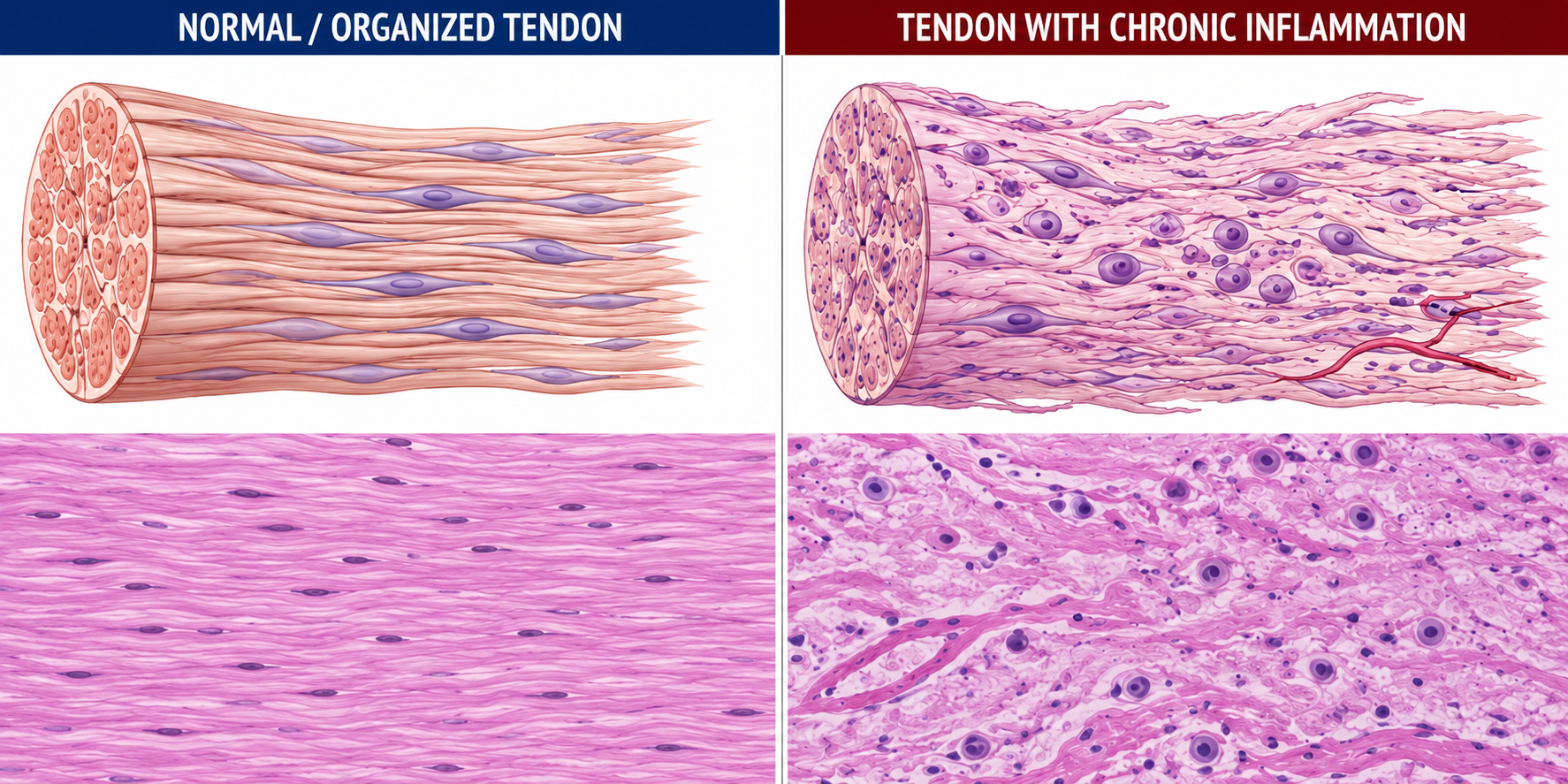
Over time, chronic inflammation can alter the microscopic structure of tendons and fascia.
Here’s how that impacts you:
1. The tissue becomes disorganized
Healthy tendons and fascia are made of neatly aligned collagen fibers, similar to strands in a strong rope. Chronic inflammation causes these fibers to:
- Lose alignment
- Become more randomly arranged
- Form weaker repair tissue instead of strong, elastic tissue
This means the tissue is less efficient at handling load.
2. Reduced ability to handle stress and stretch
When inflammation sticks around:
- The tissue loses some of its natural stiffness and recoil
- It becomes more vulnerable to micro-tearing
- Normal activities (walking, standing, running) can start to feel painful
This is why pain can show up without a specific injury.
3. Slower healing and poorer repair quality
Inflamed tissue doesn’t heal as well because:
- Blood supply can be impaired
- Healing cells don’t function as effectively
- The body lays down “patchwork” tissue rather than rebuilding strong fibers
This often leads to a cycle of pain → rest → flare-up → repeat.
4. Increased risk of degeneration and tears
Over time, chronically inflamed tendons and fascia are at higher risk for:
- Tendinosis (degenerative tendon changes)
- Partial tearing
- Recurring plantar fasciitis
- Pain that returns as soon as activity increases
The tissue isn’t just painful, it’s structurally weaker.
Why pain doesn’t always equal damage
An important thing to understand: you can have significant tissue changes without severe pain, and you can have pain without major damage. Chronic inflammation sensitizes the nervous system, making tissues feel more painful even during everyday use.
This is why imaging doesn’t always tell the full story and why treatment needs to address more than just symptoms.
What helps restore tissue strength?
The goal isn’t just to reduce inflammation—it’s to teach the tissue how to be strong again.
Effective recovery often includes:
- Progressive loading exercises to realign collagen fibers
- Improving movement mechanics so tissues aren’t constantly irritated
- Manual therapy to improve tissue mobility and blood flow
- Adequate recovery, sleep, and stress management
- Gradual return to activity, not complete rest
This is where physical therapy plays a key role, helping calm inflammation while rebuilding strength in a controlled, safe way.
The takeaway
Chronic inflammation doesn’t just cause pain, it changes the structure and strength of connective tissues like tendons and the plantar fascia. Without the right approach, these tissues can become weaker, slower to heal, and more prone to recurring injury.
The good news? With the right guidance and progressive care, connective tissue can adapt, remodel, and regain strength, even after long-standing pain.
If your pain has been lingering longer than expected, it may be time to look beyond “just inflammation” and focus on restoring tissue health from the inside out.